Theory No. 02

oneTHNGWax
Theory

The record is the effect. Drop the needle.

One knob: where the needle is sitting on the side. Groove speed under the stylus falls as the arm walks inward, and nearly every audible record artifact is a function of that one number. Turning in does not fade four effects up together. It moves the needle.

Try free, 14 days

VST3 and AU. macOS and Windows. No iLok, no dongle, no account.

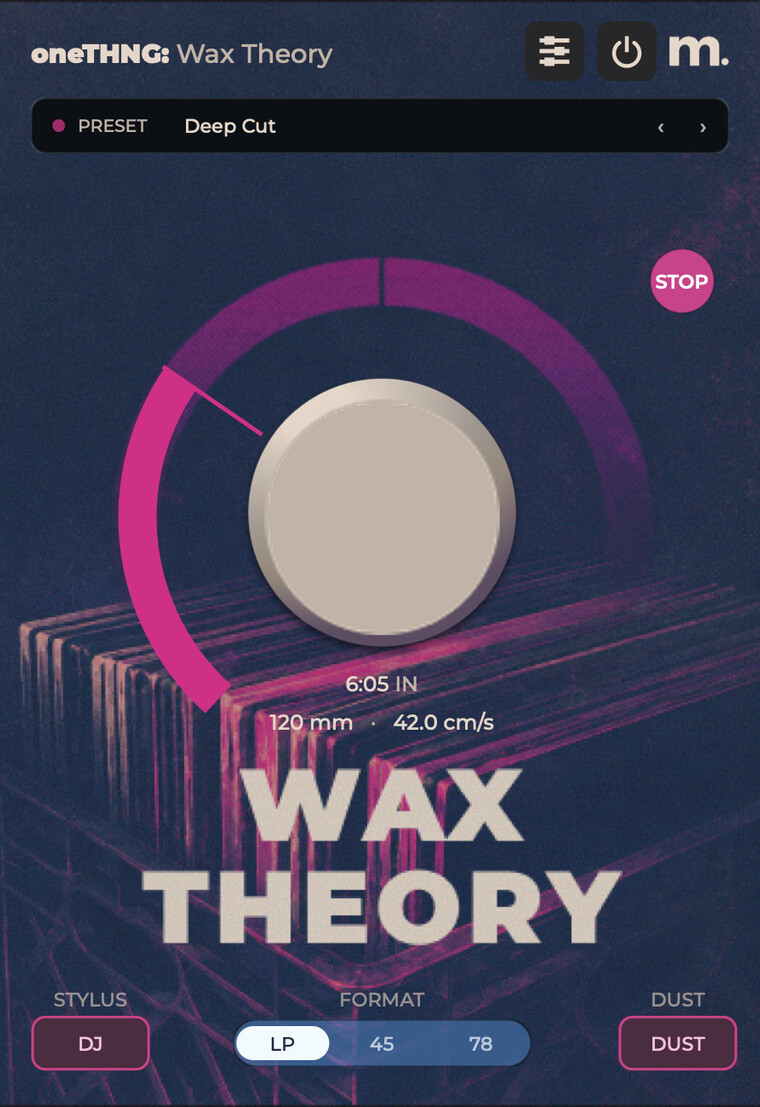
The oneTHNG Wax Theory plugin panel, showing the SIDE knob with the readouts beneath it and the STYLUS, FORMAT and DUST switches along the bottom edge.
About 51 cm/s to 21 cm/sGroove speed under the stylus, falling across an LP side. One SIDE control covers it, lead-in at the outer edge to run-out at the label.
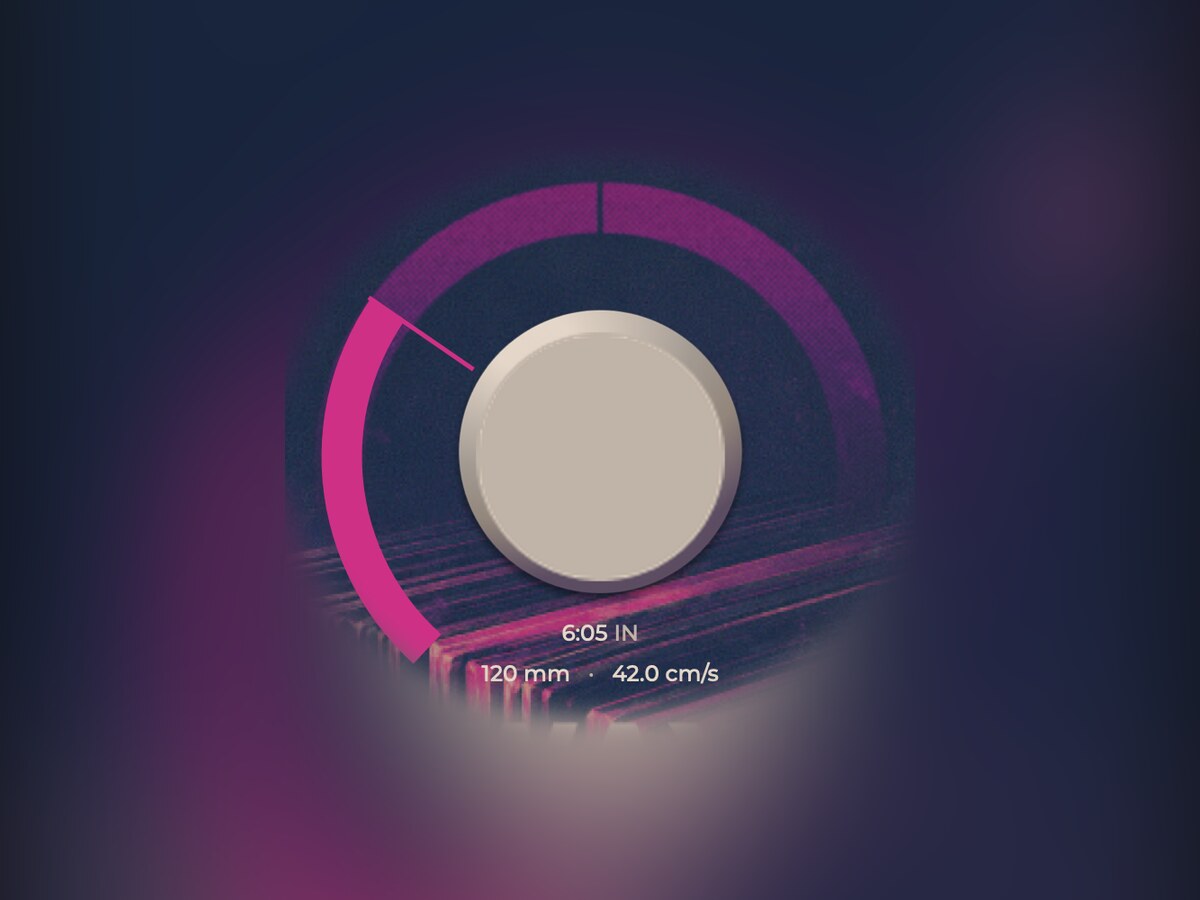
Two live lines under the knobMinutes and seconds into the side, then the groove radius in millimeters and the linear velocity in cm/s under the tip.
One knob, three switches, one gestureFORMAT is the disc: LP, 45 or 78. STYLUS is the needle: HIFI, DJ or WORN. DUST is the surface. STOP brakes the platter.

One Theory. One Knob. oneTHNG™

Hear it

A/B it against your own ears

Hit BYPASS at any point and the untouched signal takes over without losing the playhead. Every demo is one take bounced twice at matched loudness, so what you hear change is the record, never the volume.

The Wax Theory panel

Now Playing  
 
0:000:00
Hearing wet
Space play or pause B toggle bypass All demos rendered at matched loudness.
The theory

One knob.
The whole side.

Almost every audible record artifact follows from a single number: the speed of the groove under the stylus, which falls steadily as the arm walks inward. On an LP it is about 51 cm/s at the lead-in and 21 cm/s at the run-out.

Tracing distortion, surface noise, wobble and bandwidth are not four effects to balance. They are four consequences of one position. So the side of a record is the knob, and you find the spot by ear.

Turning it in moves the needle: tracing distortion climbs, surface noise comes up, the wobble deepens, the top end closes down.

The knob is a condition axis as well as a position. A sealed copy at the lead-in becomes a crate record by the run-out, and that ramp is smooth, weighted toward the upper half and full at the top, with no point where anything switches on.

The untouched signal is not on this knob at all. The lead-in is a well-aligned deck with a well-centered pressing, not a bypass. The power button in the top bar is the honest A/B, and that is what you should use for one.

One position, four consequences
6:04 in120 mm · 42.0 cm/s

Live. Drag, scroll or use the arrow keys.

The controls

One panel

One knob, three switches, one gesture. Knob moves are smoothed and the switches crossfade, so everything here is safe to move while audio is playing. It is built to be performed, not only dialed in and left.

The SIDE knob and its arc, with the live readouts beneath it.
SIDE · the knob

Where the needle is sitting

Fully counter-clockwise is the lead-in at the outer edge; fully clockwise is the run-out at the label. Everything follows from it, because groove speed under the tip falls as the arm walks in. The default is 30 percent — six minutes into an LP side, within a millimeter of the outer null of the arm’s alignment, and the quietest point on the side for tracking-error distortion.
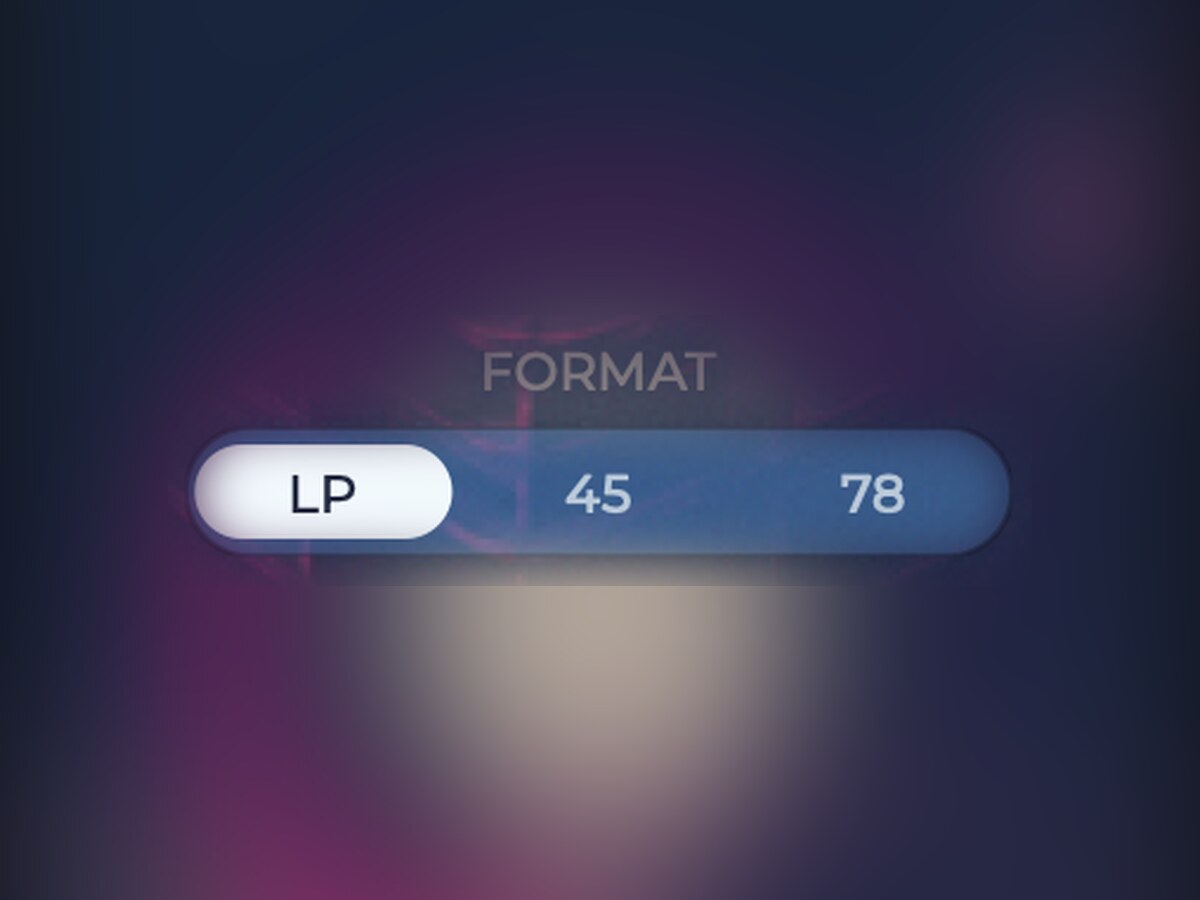
The FORMAT switch on the panel, set to LP, with 45 and 78 alongside it.
FORMAT · LP, 45 or 78

The physics of the disc

Not the tilt of an EQ. LP is a 12-inch at 33⅓, a 20:15 side with the widest range under the knob: full bandwidth at the edge, real inner-groove trouble at the end. 45 is a 7-inch, a 4:00 side — a faster groove is cleaner per inch, but the side is short, so the whole arc is compressed. 78 is a 10-inch shellac: a 200 Hz to 3 kHz band, mono below 500 Hz, a much louder and busier surface, and a per-record speed error of up to ±6 percent.

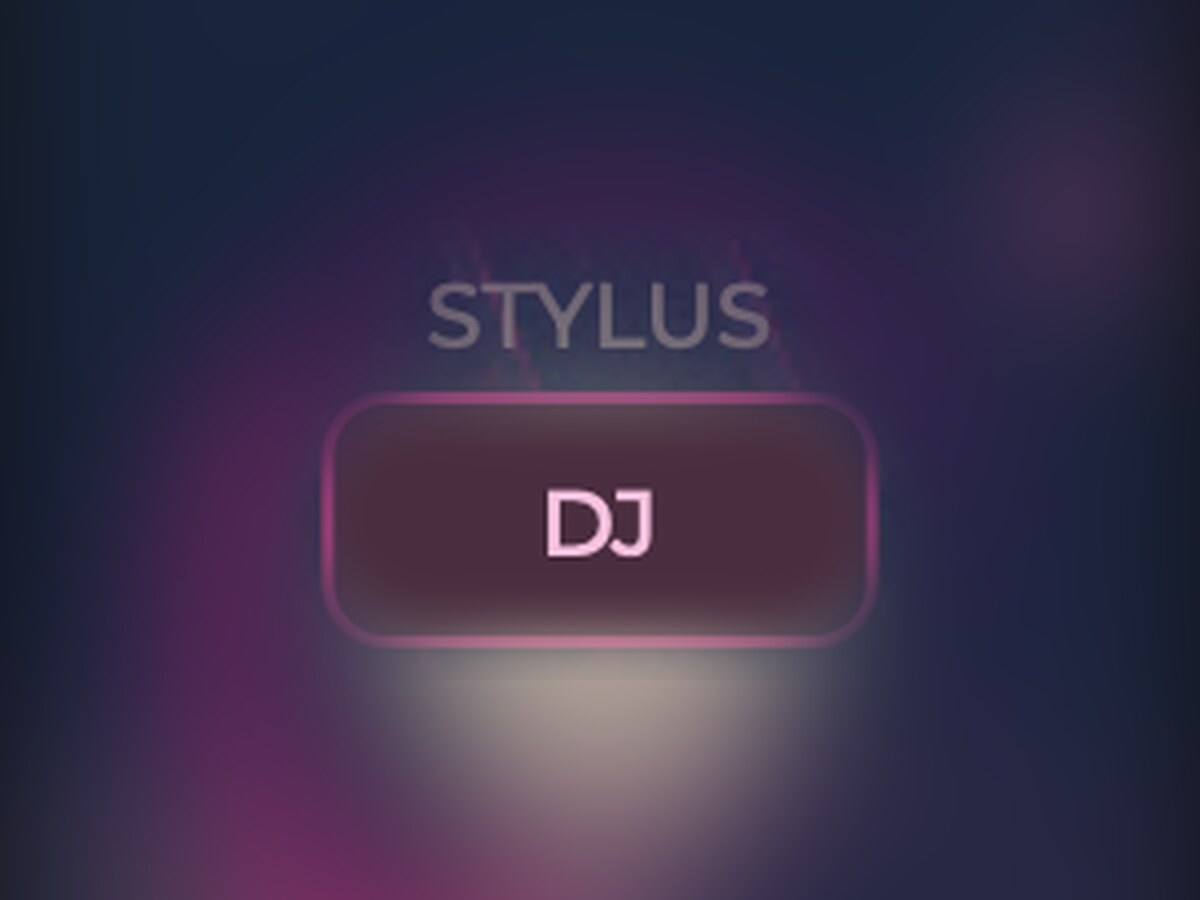
The STYLUS switch on the panel, set to DJ, with HIFI and WORN alongside it.
STYLUS · HIFI, DJ or WORN

Who is reading the groove

The record does not change; the needle does. HIFI is an elliptical tip, flattest and cleanest out to 22 kHz, so the side position is the whole effect. DJ, the default, is a conical: about 2.25 times the tracing distortion, a presence lift near 7 kHz, and a top end that stops around 17 kHz — the sampled-off-a-record sound. WORN is the DJ tip a few hundred hours in, with a flat that holds the signal briefly at every zero crossing, so its rasp is level-independent and stays audible in quiet passages.

The DUST switch on the panel, on.
DUST · the surface

Four things under one switch

A surface bed, dust ticks that arrive in clusters, one scratch pop per revolution landing exactly on time — 1.8 seconds on an LP — and bearing rumble, all injected at the groove so the cartridge reads them like the music. The bed, ticks and pop rise as the arm moves inward; the rumble does not care where the arm is. Off is genuinely off, but it only removes the surface: bandwidth, tracing distortion, warp and the groove echo are the record itself and are always on.

STOP, the accent circle at the upper right of the panel.
STOP · the gesture

The platter brakes on its own inertia

Engage it and pitch falls, the wobble slows with the deck, tracing distortion climbs and the top end collapses as groove speed dies, while the surface noise fades out with the motion. Then the record rests, and the noise rests with it. From 33⅓ that takes 0.700 seconds; from 78, 1.638 — one inertia sets all three timings. Release it and the deck spins back up, with fresh audio sliding into pitch rather than a replay of the stall. Latching and automatable, so the gesture can be sequenced.

Cutting stage›The pressing›Surface›Stylus›Platter

The cutting stage rearranges the low end before anything is pressed, the surface lives in the groove ahead of the needle so the cartridge reads dust the way it reads music, and everything rests when the platter does — noise is a tip tracing motion.

The oneTHNG series

Wax Theory is No. 02 of three. Each Theory is its own question and its own experiment, one a month.

See the series
Documentation

Read it before you buy it

No gate, no address, no waiting. Two editions, because a desk reference and a field book are not the same document. Read either one before you spend anything.

Formats VST3 · AU macOS 11+, Apple Silicon and Intel Windows 10+, 64-bit Full specs in the manual ›

The record is the effect.
Drop the needle.

Fourteen days at full quality. No account, no key, no card.

Try free, 14 days